Sunday, January 25, 2009

East of Eden

“I just want to
Yes, I want to be inside
When Zion Gate close

Yeah, I don't want to be outside”

Zion Gate - Horace Andy

Last month, I started reading Bio Bible .

History is biography after all. And what better narratives are there of God’s interaction with humankind than the biographies in the Bible?

“Day Three” is the story of Cain and Abel, the first two children of the first two humans God created.

We know that Abel killed his brother Cain because of his anger. Something about offerings. But what is interesting is that God’s punishment was not the death penalty. It was not “An eye for en eye.” It was separation…from God, and from those Abel was close to in Eden. Abel was told he would become a “restless wanderer,” in the land of Nod, east of Eden.

I have a feeling that we are actually more afraid of separation than we are of death. In the Christian faith, death doesn’t mean we cease to exist. It means either ultimate union, with God and His family, or ultimate separation. The latter is scary. I think we sense that deeply inside.

When God pronounced His sentence on Abel for his murderous act, Abel said,

“My punishment is more than I can bear.”

“I will be hidden from your presence.”

“I will be a restless wanderer on the earth, and whoever finds me will kill me.”

However, God puts a mark on Abel so that no one would kill him. But Abel is separated.

Paul tells us that, “…the wages of sin is death, but the gift of God is eternal life in Christ Jesus our Lord.” (“Sin” is a loaded word that has too often come to mean a lot of man-made “don’ts” that God never intended. That was the case in Jesus’ day, and it is now. On the other hand, there is such a thing as sin. It is putting self over others. My favorite “operational” definition of sin is anything we do that ultimately causes harm to ourselves, or others.)

But before and after death, there is separation.

Sin rips us apart, and from community with God and others. It corrodes, and finally breaks the bonds we have with a loving God and with those close to us.

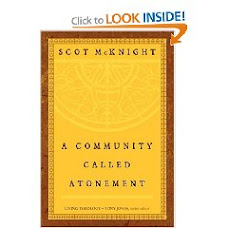
In His infinite grace, God provides a way back. Atonement is the way back. It comes through the death, and resurrection of Jesus. My favorite book of 2008 was Scot McKnight’s A Community Called Atonement.

Atonement is God’s mission to reconcile not only each of us to Himself, but to each other, to restore our brokenness and to reconcile us to His world. As McKnight puts it, “Atonement creates the Kingdom of God.”

Atonement is the answer to our sin, and separation, and death. Atonement is reconciliation, and oneness, and wholeness, and life, now and forever. In the end, it allows us back into Eden.

(By the way, did you ever wonder who all those people were living outside of Eden who Cain was afraid of?)

Blessings,

Steve

Monday, January 19, 2009

“Do”-ing Church?

I was with a group of fellow Christian men last night, gathering for our weekly dose of spiritual banter, coffee and treats, and many times musical exploration (some are way better than others). This is always an eclectic group of people and we generally disagree on most about everything. Last night it was creation, evolutionary theory (even as a possibility), and young vs. old earth. I will save you from the details…

However, while meeting there was a wonderful question that resonated with me concerning what it means to “do” church. Now for a small background…some of that group are very “emerging” as it pertains to theology and church practice…some are very “traditional” in their theology and church practice…with many who would claim aspects of both.

In a slight shot at the emerging movement and its various forms on nontraditional church expressions and gatherings, a friend asked about their preoccupation concerning “do”-ing church. Particularly because the movement argues that traditional church models have got it wrong. He asks, “Why do we continue to talk about how to “do” something that is understood, theologically speaking, as a reality simply because we are a part of this cosmic powerful all encompassing Body of Christ? “ (I paraphrased and embellished a bit).

I would like to propose that “Christians” (in the sense that someone places their faith in Christ and seeks to follow Him) should think of “do”-ing church, not as a function or special gathering, but rather as a growing awareness of those times in which church is a reality because Christians are spending time with each other.

Church (ecclesia), or a gathering of a called apart people, is nothing more than those people being together for the purpose of which they are called. If together, and that gathering is marked by the purpose of which it is formed (namely to Love God and each other), then it should be called “church.”

Now, one must consider that the word has a certain level of implication that there is more than one for instance….It isn’t really a “gathering” if it is just you, even if you tend to have leanings similar to Me, Myself & Irene. I have thought during times of musing that if God is always present, the Spirit of Christ dwells within us, and Jesus is listening and advocating on our behalf…oh, and I can’t forget the Devil who is ever present to trip us up and seduce us with sin…then even as I sit here typing this I am in community. Not to mention the hordes of angels that surround us, singing praises to God and being the servants of His children.

…I paused for lunch….a gathering with four Christians around a wonderful Indian buffet…talked Christian

I have to admit…that the lunch was a beautiful expression of Christ’s Church…we didn’t incorporate, have an agenda, or even play music…but we worshiped God in our discussion and loved each other through the community. The four of us may never be together again in one setting, but the marks of lasting change will be evident in our lives…may you all grow in awareness of the church that happens all around us.
(All references made in this blog can be found in the Bible, please enjoy the process of finding them)


Grace and Peace,
Robin Martin, M. Div

Sunday, January 11, 2009

January 09 Meeting

“Church is the only organization ever created for the benefit of its non-members.” *
Matt N. (Broward Emerging Christians - BEC Meetup member)

At right, Constantine I, Emperor of the Roman Empire Head of Constantine's colossal statue at the Capitoline Museums - image by Jean-Christophe Benoist
(Go
here for link to the article Constantine I and Christianity)

Fourteen of us met at Laura’s Cuban Restaurant on El Día de los Reyes to continue our conversation about new/old ways of doing church and Alan Hirsch’s book The Forgotten Ways. In the excerpt of his table below, Hirsch compares two modes of church like this:

Organic Missional Movement vs. Institutional Religion
Seeks to embody the way of life of the Founder - vs. - Represents a more codified belief system
Has a cause - vs. - Is the cause
The mission is to change the future - vs. - The mission shifts to preserving the past
Tends to be mobile and dynamic - vs. - Tends to be more static and fixed
Decentralized network built on relationships - vs. - Centralized organization built on loyalty
People of the Way - vs. - People of the Book

Hirsh also compares what he calls, “Apostolic and Post Apostolic Mode” (AD 32 to 313) and "Emerging Missional Mode" (past 10 years) to “Christendom Mode” (313 to present). He generally demarcates at 313 because that is the year that Emperor Constantine made Christianity the state religion of the Roman Empire. While that act ended Christian persecution in the Empire and largely set the stage for the spread of Christianity throughout Europe and abroad, it also, in Hirsh’s view had a series of unintended consequences that have shaped the church to this day. Here is an abbreviated list that Hirsch includes as taken from Stuart Murray’s book, Post-Christendom: Church and Mission in a Strange New World:

The movement of the church from the margins of society to its center

Infant baptism as the symbol of obligatory incorporation into this Christian society

The definition of “orthodoxy” as the common belief shared by all, which was determined by powerful church leaders supported by the state

A hierarchical ecclesiastical system, based on a diocesan and parish arrangement, which was analogous to the state hierarchy and buttressed by state support

The construction of massive and ornate church buildings and the formation of huge congregations

The increased wealth of the church and the imposition of obligatory tithes to fund the system

A generic distinction between clergy and laity, and the relegation of the laity to a largely passive role

The defense of Christianity by legal sanctions to restrain heresy, immorality and schism

The use of political and military force to impose the Christian faith

Hirsh concludes that this shift to Christendom was “…absolutely disastrous for the Jesus movement that was…transforming the Roman world from the bottom up.”

Jim R. started our discussion by sharing what brought him to the emerging conversation. He was born in the 1940s and came from what he described as a strict fundamentalist / Methodist background having only seen his first movie at the age of fifteen. It was also at fifteen that he became “certified” in his denomination and began to preach. Preaching however, he later decided was more his mother’s idea than God’s and he stopped. He attended Asbury College and worked in the field of accounting for many years. He also teaches adults in the church he attends. His gift for teaching benefited by his earlier studies of Greek.

Jim said that he “became emergent before the word was coined.” By this he means that he is typically zealous in “challenging everything.” (Such an attitude might be considered by Hirsch as part of the fivefold ministry in Ephesians 4. As Hirsh puts it, “…disturbing the system is a critical function of [missional] leadership. It is about creating conditions in which change, adaptation, and innovation will take place.”) Two scriptures Jim says influenced him were, “Do your best to present yourself to God as one approved, a workman who does not need to be ashamed and who correctly handles the word of truth.” (2 Timothy 2:15) and “All Scripture is God-breathed and is useful for teaching, rebuking, correcting and training in righteousness, so that the man of God may be thoroughly equipped for every good work.” (2 Timothy 3:16). And two books that inspired him were, Reign of the Servant Kings by Joseph Dillow which seeks a third way by challenging the systematic theologies of both Arminianism and Calvinism, and A Life God Rewards: Why Everything You Do Today Matters Forever by Bruce Wilkinson. Jim summarizes what he learned in a hand-out he gave us that says, “Our eternal DESTINATION is the consequence of what we BELIEVE on earth. Our eternal COMPENSATION is the consequence of how we BEHAVE on earth.”

One of the things Jim challenges is the ordination of professional clergy claiming it is not found in scripture, and in practice does not appear until the time of Constantine.

Robin commented that there are examples of the laying on of hands to anoint those who spread the Gospel. Jim responded that even Paul the Apostle was “bi-vocational” and worked as hard as he could to avoid being financially dependent. We also discussed the origin of the “pulpit to pew” preaching style. Did Jesus and Paul give us examples of it or did it start in the way we know it today with Martin Luther as some claim?

In our ensuing discussion comparing the modes of “attractional” or “institutional church” with “organic missional movements” and “incarnational-sending church,” Kelly commented that in institutional church mode the “primary reason is eternal destination” whereas in missional mode the emphasis is more on “transforming our lives and the world.” We talked about how institutional church sometimes “boils down” the Gospel message in order to make it accessible to the point where it often loses its relevance to our lives, whereas when Jesus spoke in parables he spoke of a full gospel in the context of the real life situations of his hearers. In discussing the comparison of, “People of the Way” vs. “People of the Book,” Megan felt that non-Christians (and many Christians) might view the Bible as a legal text versus reading it to come to understand a new way of life. Robin said the approach to reading the Bible should be to know and follow God versus focusing on “sin management.”

We asked how we are and can be missional both as individuals and within community. Matt who is part of incarnating Jesus among the homeless with a group called “Love Bags” (see Aug. 13, 2008 post) told us about how one of the homeless people they have “church” with out in the street regularly, decided on his own not to wait for the weekly “Love Bags” event and held a “church service” on his own with his friends and put up a Christmas Tree they lit with some (eh hmm) “borrowed” electricity. Matt also told about regular dinners he’s been part of where friends and neighbors, both Christians and people who are not, have become very close. Kelly brought up an idea to reserve a table for twelve where three Christians might invite nine strangers to dinner just to eat and chat. Megan and Robin reminded us that conversations can naturally go to spiritual topics without having to “lead” the discussion. From people we meet at parties to bartenders, we are finding that there is such a thirst right now for deeper meaning and community that such conversations often happen spontaneously.

Due to the size of the Meetup this week, we formed two smaller discussion groups for part of our time. Wendy summarized her group’s discussion about institutional churches as their being, “too big and top heavy, locked into budgets and programs” and suggested that church could be smaller and more sensitive to the Spirit (“God in us directing what we do”) and more about caring for one another. They said, “Don’t put the job on the ‘leader’ that we’re supposed to have.” And that we should recognize that Christ is not only “in” us but needs to spread “out” of us, and that “worship is your life.”

We decided to meet again on Tuesday night, February 3rd and if anyone wanted to bring together any kind of gathering in the meantime, we’d announce that through Meetup.

Peace and blessings,

Steve

*This paraphrase is from an original quote by Archbishop of Canterbury, William Temple who said, "The Church is the only society that exists for the benefit of those who are not its members." (Thank you to an alert blog reader :^)

Wednesday, December 24, 2008

Christmas Hope for the Future

"How does one know that God is good if not through the actions of people who claim to know him and the inactions of those who claim not to?” - Jim Rice, Charlotte, NC Emergent Cohort member

At left: Archbishop Desmond Tutu

I was asked to say a few words about “Christmas Hope for the Future” as part of the Christmas presentation last Sunday at church. Here’s what I said:

By the third Chapter of genesis, we’d blown it so bad that God said to Adam, “You are banished…from the Garden of Eden to work the ground from which you had been taken.”

But God wasn’t done. In the second chapter of Luke, God bypasses the religious authorities and sends a messenger, an angel, to shepherds in the fields. That would be like sending the message straight to homeless people today:

"Do not be afraid. I bring you good news of great joy that will be for all the people. Today in the town of David a Savior has been born to you; he is Christ the Lord…Glory to God in the highest, and on earth peace to men on whom his favor rests."

God turned it all around. In His grace and mercy He sent us a savior. A savior not only to reconcile us to God, but as Jesus said of his own mission:

"The Spirit of the Lord is on me,
because he has anointed me
to preach good news to the poor.
He has sent me to proclaim freedom for the prisoners
and recovery of sight for the blind,
to release the oppressed,
to proclaim the year of the Lord's favor."

In thinking of Christmas hope for the future, just like the writer of Hebrews reminds us, we do well to remember our great cloud of witnesses and the acts of faith they were commended for, from the time of Jesus right up through the present and into eternity.

So many of us have our own testimonies, of salvation, healing, reconciliation, and awakening. And God’s Spirit has been at work through the centuries …

Preaching good news to the poor.
Sending His church to proclaim freedom for the prisoners
and recovery of sight for the blind,
and releasing the oppressed.

When have we seen this?

When tens of thousands of Christians stood by candlelight in the town squares of Eastern Europe until the Iron Curtain fell.

When Rev. Dietrich Bonhoeffer stood against Hitler, who was defeated, and Israel was born.

When Mao tried to eradicate Christianity and religion in China by killing millions. But now the church of Christ in China is one of the fastest growing in the world.

When Archbishop Desmond Tutu worked to end South African Apartheid. When Christian Member of Parliament, William Wilberforce worked for the abolition of slavery in England. When slavery was then ended in America, followed by Jim Crow laws and segregation through the work of Rev. Martin Luther King, Jr., through to the election of an African American US President.

God calls each of us to carry Christmas hope to the poor, the imprisoned, the blind and the oppressed. Who among us will be a Bonhoeffer, a Wilberforce, a Tutu, a King or a president?

Our Christmas hope for the future is in the Kingdom of God, that Christ ushered in, spreading as a light in this dark world until Jesus returns.

Christmas hope is in the atonement brought about by the Christ child, reconciling us with God, with one another in community, making us whole within ourselves and reconciling us to the world, and the world to God.

Christmas blessings!

Steve

Saturday, December 20, 2008

December 08 Meeting

“Relationship is the essence of God…intimacy with God and each other.” – Anthony (BEC Meetup Member)

(Pictured at right: BEC Christmas gathering at Robin & Melissa’s)

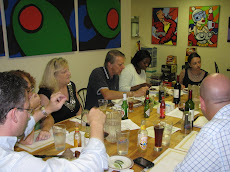
Twelve of us gathered for our December Broward Emerging Christians (BEC) Meetup at Laura’s Cuban Restaurant in Hollywood to continue our discussion about emerging / missional ways to do church. We started, as has become our custom, with one of us sharing our story of what led us to the emerging conversation and to this table. This time, Kelly shared. Although it was his first time joining us (due in part to his travel schedule) he offered a unique perspective of having left a local mega-church to start “Epic” which began as, “An Emergent Church Community” in North Broward, but now prefers to eschew even those labels. You can find out more about Epic here: http://www.epic-remix.org/

Kelly grew up as a missionary kid (“MK”). After spending time in Peru he and his wife settled back in the U.S. in a mega-church and loved it and eventually went on staff. At the same time, he found himself asking questions about what the essentials vs. the non-essentials of the Christian faith are (see also Scot McKnight's discussion on this topic at http://blog.beliefnet.com/jesuscreed/2008/12/friday-is-for-friends-96.html#more ). And he found through ongoing global missions work that even other missionaries in Africa were asking many of the same questions. These questions involved matters like the Second Coming of Christ, rules related to tithing, expectations of how Christians are supposed to vote, and many others. He questioned the millions of dollars it cost to run the mega-church with its hundreds of staff, compared to the benefits for the Kingdom of God. In the mega-church, the answers were pre-packaged, and if you didn’t like the package being offered, there was push back.

Kelly decided that God may be speaking through his questioning, and if He was, he wanted to be listening and push through and not look back later and regret that he hadn’t. This process of asking, listening and reading is what led him to the emerging conversation. He tried to share what he was learning with leaders of the mega-church and after two frustrating years simply got a firm “no.” Opposition from the mega-church to what he perceived to be a process of spiritual growth led him to “step off a cliff” into bi-vocational ministry in the emerging church movement and to start the “Epic Re-mix” community in North Broward County, FL. While scary, this move was also exhilarating and allowed him to be part of a community where people were free to ask questions and wrestle with the answers and where it would be OK to disagree. He wonders if that is part of what being “one” means as Jesus describes it in John’s Gospel.

Now, Kelly found less of a disconnect between what he represented to those around him and who he really was. He also found less of a disconnect between the church community and those outside of it. On the one hand, he often observed people outside of church acting like better Christians than those in the church. At the same time, the emerging / missional church community was freer to embrace those on a journey, without focusing so much on whether they’d “arrived.” In the extreme, he summed up the divide viewed by many of those “inside” the church, compared to those “outside” the church, with this slogan, “Good for us, to hell with you.” This resonated with others in the group. Kelly now no longer felt he had to “sell” something to people and could focus more on authentically loving God and loving others.

Reactions, and more discussion on how we do “church”…Anthony observed that when Jesus was here, “He caused a ruckus” and reminded us of his conflict with the “religious system” to the point of using a whip to drive the money changers out of the temple area. He also said, “Church is not a building. We are church.” And he posed this question to us, “What if we treated each other with the same reverence that we treat sacred temples with?”

Matt, Robin & Steve F. looked for balance and the way forward. Emerging / Missional Christians don’t look to “attract” to a church per se but go out to “be” available as the church, as the Body of Christ in the world. At the same time, “Generous Orthodoxy” means we don’t have to get other Christians to stop going to their inherited/institutional churches. But we are available there too to help promote re-missionalizing or “re-traditioning” (Described by Phyllis Tickle as staying in one’s inherited church while energetically wishing to make it more fully what it originally was) in the church. The thrust is to broaden the reach and definition of church from 2 hours on Sunday to a 24/7 way of spiritual life (See also Rob Bell’s “Everything is Spiritual” http://www.youtube.com/watch?v=Poi3imQkQsQ ).
We also need to be careful not to take on an air of superiority in pointing out shortcomings of other church modes, but to be about the business of humbly suggesting and living out solutions.

We returned to discussing Alan Hirsh’s book The Forgotten Ways http://www.theforgottenways.org/intro/ in the area of leadership ethos. Here, Hirsch compares post-ConstantinianChristiandom Mode,” defining it as “Leadership by institutionally ordained clergy, thus creating a professional guild operating primarily in the pastor-teacher mode” to early church and “Emerging Missional Mode” where “Leadership embraces a pioneering-innovative mode including a fivefold ministry-leadership ethos. Noninstitutional by preference.” Are these legitimate demarcations? We agreed that both modes have always operated in the church but there have been times when one is dominant over the other and that there is often conflict between modes.

The downside of a professional ministerial guild is that it can serve to maintain the power and financial status quo for the professionals while withholding significant leadership roles from other Christians. It promotes hierarchical religious systems (similar to those Jesus confronted) including state religion. With such strong systems in place, the Holy Spirit can easily be sidelined without it being apparent to many.

On the other hand, the benefit of fivefold ministry described in Ephesians 4 (Apostle, Prophet, Evangelist, Pastor, Teacher - known by the acronym APEPT) is that all Christians use their gifts. Leadership is distributed and church spreads as an organic, grass roots Jesus movement. If a church stays in a box just to survive, it is actually sowing the seeds of its own death. Scott commented that churches often reach only for the safe, for the probable and possible, when we should be going for the impossible.

Finally, Anthony concluded with these thoughts, “Relationship is the essence of God…intimacy with God and each other.” And he asked, “Why does the pastor have to invite people to their home? People should invite people to each other’s homes." Wendy and others agreed and after some discussion, Robin & Melissa did just that and invited us all to their home for Christmas fellowship which was held on December 19th. You can see some of the comments and pictures here: http://emergentchristian.meetup.com/29/calendar/9288939/

We’ll meet again at Laura’s Cuban Restaurant on Three Kings Day, Tuesday, January 6, 2009 and continue our fellowship and our discussion of “The Forgotten Ways.”

Peace and blessings this Christmas and New Year,

Steve

Friday, November 28, 2008

Who's Your City?

“The poverty in the West is a different kind of poverty---it is not only a poverty of loneliness but also of spirituality. There’s a hunger for love, as there is a hunger for God… In the West there is loneliness, which I call the leprosy of the West. In many ways it is worse than our poor in Calcutta.”

- Mother Teresa

I am writing this on “Black Friday,” the most important shopping day in the American economy. My wife (who is shopping with a relative as I write this :^) shared with me a little bit from a book she is reading this morning. We share what we are reading with each other a lot.

In his book, Who’s Your City?: How the Creative Economy Is Making Where to Live the Most Important Decision of Your Life, Richard Florida counters some of the theory that the world is “flat” (that you can succeed anywhere you live due to the Internet) and says that innovation and investment tend be clustered in what he calls “mega-regions.” (He counts “So-Flo,” including Miami, Orlando and Tampa, as such a region.) Why is that? One reason is relationship. Even with the Internet, entrepreneurs and inventors want to see what they are investing in and who they are sharing ideas with in person, and they don’t often like to travel far to do it.

Florida talks about why place matters in a variety of contexts. Here is one fascinating bit of data he includes:

“A 2007 study by economist Nattavudh Powdthavee of the University of London used survey data to estimate the monetary value of frequently seeing friends and relatives. The study found that seeing friends or relatives in person almost every day is worth more than six figures in additional income. For example, Powdthavee found that if you relocate from a city where you regularly see your family and friends to one where you would not, you would need to earn $133,000 just to make up for the lack of happiness you feel from being far from those people. Powdthavee drives home the importance of making a conscious choice about your time when he writes, ‘Since it normally requires both time and effort to achieve either higher income or a stable social relationship with someone, the weight attached to each individual’s investment decision thus depends on the type of possession - money or friendship – that he or she believes will yield a larger impact on happiness than the other.’”

How does this relate to our understanding and practice of emerging and missional church? Can "critical mass" for mission be jump started in our church communities through the idea innovations and interpersonal time investments of the spiritual entrepreneurs in our friendship networks? What ideas are we sharing, and who are we investing in? Also, as our consumer driven Western society continues its economic melt down, maybe it is time to reassess our priorities. In his book Everything Must Change, Brian McLaren writes, “First, Jesus addresses the law of progress through rapid economic growth. In its place, he offers the law of good deeds for the common good….Second, Jesus overturns serenity through possession and consumption. Instead, he envisions satisfaction through gratitude and sharing.” That can be our vision this Thanksgiving and Christmas (otherwise known as the great retail season) and that can be our vision for God’s church. How do we invest our time…in people or things? What is the result, not only to our own happiness and effectiveness but to the happiness of those around us? I am not saying that reward for hard work is wrong. I think what the Gospel tells us though is that there might be something missing from the so-called “American Dream” that can be found when we truly seek first the Kingdom of God, starting with Jesus and His people, our relatives and friends, and extending through an ever expanding social network to those on the margins of society.

My wife will come home and it will be a big deal if she bought even one ridiculously discounted garment (she rarely buys much of anything when she goes shopping, and she doesn't go shopping much). But the time spent with our relative will have been (in the words of the commercial) priceless.

This week, a friend of mine shared his yearning to be more intentional about having a time of regular worship with his wife and kids. Just such a place and time can be where the spark of revival starts.

Join us this Tuesday http://emergentchristian.meetup.com/29/calendar/9151159/ as we continue to share our thoughts about Alan Hirsch’s The Forgotten Ways and “community around natural discipling friendships, worship as a lifestyle, and mission in the context of everyday life.”

Steve

Saturday, November 22, 2008

Sisters, Brothers

One love, one blood, one life, you got to do what you should.
One life with each other: sisters, brothers.
One life, but we're not the same.
We get to carry each other, carry each other.

One...life

U2 - One, from their album Achtung Baby

We often hear this phrase, and variations, “Jesus is all you need.” While no doubt true in its context, have you also seen cases where this notion became an excuse to cop out on relational responsibilities Jesus expects of us in regards to one another? What did Jesus tell us? On his last night, Jesus left us with these words, "A new command I give you: Love one another. As I have loved you, so you must love one another. By this all men will know that you are my disciples, if you love one another." - John’s Gospel, Ch. 13:34-35. In the next chapter, Jesus repeats this command two more times, and elaborates with the metaphor of the vine, and then says, “I no longer call you servants, because a servant does not know his master's business. Instead, I have called you friends…”

On Veterans Day, I drove my wife Kathy and a friend of ours to a book signing in Miami. We got to talking over lunch and our friend told us about a book she was writing. Turns out our friend grew up in a non-Christian home but was attracted to the message and way of Christ at an early age through people in her neighborhood. She recently became Catholic. She sent us a couple of chapters in her book and I had a chance to read them this morning. Her main character is Bobby, a boy who is basically good, but because he is going through puberty is getting in trouble in ways that confuse both him and his parents. After one incident where everything comes crashing down and Bobby runs crying to his room, a family friend, Rev. Jacobs, counsels him then says, “‘I have something that might help you see that even in our greatest moments of despair, we are never alone.’ He reached into the pocket of his jacket. He pulled out a bookmark and handed it to [him]. Written on it was a story titled, ‘Footprints in the Sand.’”

You know “Footprints,” where it says, “The times when you have seen only one set of footprints in the sand is when I carried you.” My question for our friend, and for us is this: Was Jesus carrying Bobby, or was He using Rev. Jacobs to?

Our friend, by the way, LG Putzer, said that if she answered the question she’d give away the secret message in her third book. (The title of the book is called Stuck in the Friend Zone. It's part of the Bobby Isaacs Chronicles.)

Who will we carry?

Steve